How Much Myoglobin Does Beef Have
Objectives:
(1) To demonstrate the relationship between myoglobin and meat color.
(2) To show how the chemical state of myoglobin is related to meat color.
(3) To identify factors associated with the discoloration of fresh meat.
Reading material: Principles of Meat Science (3rd Edition), chapter 6, pages 126 to 131.
Key terms used to describe color
Hue, chroma, and value
- Hue – words we normally think of as describing color: red, purple, blue, etc.
- Chroma – strength or dominance of the hue
- Value – overall intensity to how light or dark a color is.
L*, a*, b* color space (pronounced "L-star, a-star, b-star") for instrumental measurements
- L* – black to white
- a* – red to green
- b* – yellow to blue
Heme pigment found in myoglobin
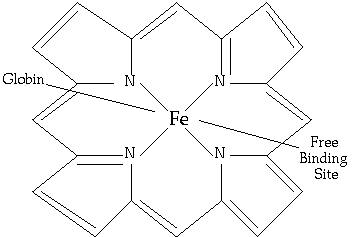
Hemoglobin — transports O2 from lungs to cells
Myoglobin — stores O2 in cells
Meat color is impacted by the following factors:
Quantity of myoglobin
Age within species — myoglobin loses its affinity for oxygen as age increases.
Myoglobin differences: Age within species
| Age class | Myoglobin content |
|---|---|
| Veal | 2 mg/g |
| Calf | 4 mg/g |
| Young beef | 8 mg/g |
| Old beef | 18 mg/g |
Species differences — age related as well as differences between "red" versus "white" muscle fibers.
Myoglobin differences: Species effects
| Species | Color | Myoglobin content |
|---|---|---|
| Pork | Pink | 2 mg/g |
| Lamb | Light red | 6 mg/g |
| Beef | Cherry red | 8 mg/g |
Type of muscle
Myoglobin differences: Muscle effects
| Muscle | Name | Myoglobin content |
|---|---|---|
| Locomotive | M. extensor carpi radialis | 12 mg/g |
| Support | M. longissimus thoracis et lumborum | 6 mg/g |
Chemical state of myoglobin
Chemical state of myoglobin -- Ferrous or Fe++ (covalent bonds)
| Compound | Color | Name |
|---|---|---|
| :H2O | Purple | Deoxymyoglobin |
| :O2 | Red | Oxymyoglobin |
| :NO | Cured pink | Nitric oxide myoglobin |
| :CO | Red | Carboxymyoglobin |
Chemical state of myoglobin -- Ferric or Fe+++ (ionic bonds)
| Compound | Color | Name |
|---|---|---|
| -CN | Red | Cyanmetmyoglobin |
| -OH | Brown | Metmyoglobin |
| -SH | Green | Sulfmyoglobin |
| -H2O2 | Green | Choleglobin |

Mancini, R. A., and M. C. Hunt. 2005. Current research in meat color. Meat Sci. 71:100-121. doi: 10.1016/j.meatsci.2005.03.003
Metmyoglobin Reducing Activity (MRA)
The system in muscle that converts metmyoglobin back into deoxymyoglobin (without oxygen) and oxymyoglobin (with oxygen) through a series of reactions until the reductants are depleted.
High MRA = M. longissimus lumborum
Low MRA = M. psoas major
Oxygen Consumption Rate (OCR)
The respiration rate of muscles over time during display, which competes with the myoglobin for enough oxygen to keep the muscle in the oxymyoglobin state.
High OCR = M. psoas major
Low OCR = M. gluteus medius
Color stability varies across muscles
| Color stability | Muscle |
|---|---|
| "High" color stability | M. longissimus lumborum M. longissimus thoracis M. semitendinosus M. tensor fasciae latae |
| "Moderate" color stability | M. semimembranosus M. rectus femoris M. vastus lateralis |
| "Intermediate" color stability | M. trapezius M. gluteus medius M. latissimus dorsi |
| "Low" color stability | M. triceps brachii – long head M. gluteobiceps (M. biceps femoris) M. pectoralis profundus M. adductor M. triceps brachii – lateral head M. serratus ventralis |
| "Very low" color stability | M. supraspinatus M. infraspinatus M. psoas major |
Source: McKenna, D. R., P. D. Mies, B. E. Baird, K. D. Pfeiffer, J. W. Ellebracht, and J. W. Savell. 2005. Biochemical and physical factors affecting discoloration characteristics of 19 bovine muscles. Meat Sci. 70:665-682. doi:10.1016/j.meatsci.2005.02.016
Two meat color problems with cooked ground beef
Premature Browning
- Usually caused by highly oxidized meat or meat that is exposed to high-oxygen atmospheres
- Meat will turn brown around 130°F internal temperature
- Reason why color is not a good indicator of cooked meat
Persistent Pinkness
- Usually caused by high pH meat
- Product will stay pink (uncooked color) even with degrees of doneness that should ensure appropriate cooked endpoint are followed.
Vitamin E feeding of cattle
Vitamin E can be fed to livestock to increase the alpha-tocopherol concentration in muscle. Alpha-tocopherol is an antioxidant and retards the conversion of deoxymyoglobin and oxymyoglobin to metmyoglobin.
Activity of bacteria
| Pigment | Catalyst | New pigment |
|---|---|---|
| Oxymyoglobin | Oxidation + bacteria | Metmyoglobin (-OH) |
| Metmyoglobin | Bacteria | Choleglobin (-H2O2 |
| Metmyoglobin | Bacteria | Sulfmyoglobin (-SH) |
Curing
| Myoglobin Oxymyoglobin Metmyoglobin | Plus NO | Nitric oxide myoglobin | Plus heat | Nitrosyl hemochromogen |
Wrapping film
Vacuum packages (polyvinylidene chloride-polyvinyl chloride); barrier to O2
Retail film (polyvinyl chloride); permeable to O2
Review of Material — What the student should know:
(1) What causes meat to have a particular color.
(2) The role of bacteria in color development and maintenance.
(3) The influence of oxygen on meat color.
(4) The chemistry behind myoglobin and meat color.
Links to related sites
J.W. Savell, revised October, 2020
Source: https://meat.tamu.edu/ansc-307-honors/meat-color/
0 Response to "How Much Myoglobin Does Beef Have"
Post a Comment